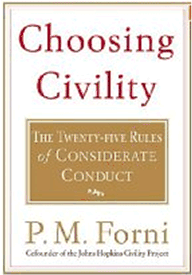
Choosing Civility
The 25 rules of considerate conduct by P.M. Forni
This one was recommended chronically by my mom until I eventually caved in; she swore mastering the rules of cilvil behavior would stand me in good stead with Coffee Coaster Website popularity. I would realize that instead of being a mean and angry SOB and screaming at everyone, if I simply 'made nice' people would come around to my way of thinking. Well, Choosing Civility is not your Emily Post sort of Oldsmobile. Or it is, but it's the muscular 442 or the sleek and fast Cutlass Supreme not the big ol' fat-assed Delta 88.
Forni points out the ethical component of civility, making distinctions with respect to eitquette, politeness, tolerance, kindness, and so on. He starts by explaining that civility's "...defining characteristic is its tie to city and society. The word derives from the Latin civitas, which means 'city,' especially in the sense of civic community." Then finishing the paragraph: "Although we can describe the civil as courteous, polite, and well mannered, etymology reminds us that they are also supposed to be good citizens and good neighbors."
Good citizens, practicing the nonaggression principle? Well, it's certainly implied isn't it? From my presentation (on the Sacred Nonaggression Principle), my significant other contributed the following key thought:
All core American values—life, liberty, equality, justice, truth, pursuit of happiness, popular sovereignty, separation of powers, rule of law, sanctity of family, and so on—assume the simple nonaggression principle. Name a value that doesn't!
And civility is certainly right up there as a key value. And this is a wonderfully useful book. The rules speak for themselves:
Pay attention
Acknowledge others
Think the best
Listen
Be inclusive
Speak kindly
Don't speak ill
Accept and give praise
Respect even a subtle "no"
Respect others' opinions
Mind your body
Be agreeable
Keep it down (and rediscover silence)
Respect other people's time
Respect other people's space
Apologize earnestly
Assert yourself
Avoid personal questions
Care for your guests
Be a considerate guest
Think twice before asking for favors
Refrain from idle complaints
Accept and give constructive criticism
Respect the environment and be gentle
Don't shift responsibility and blame
Just a readthru of the list serves as a reminder of good and prudent behavior, but in the presentation of each Dr. Forni typically provides an idea that transcends the rule. For instance, on rule #1,